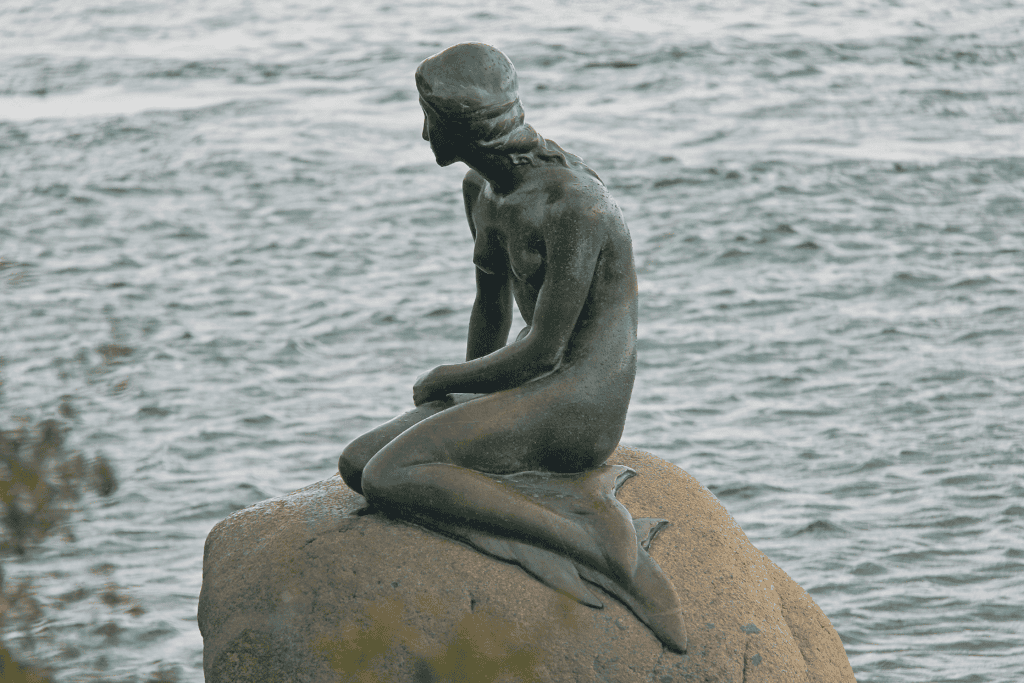
What Andersen’s Little Sea Maid Says About Voice, Silence and Eternity
I’ve been thinking about mermaids this summer. They have varied names across cultures and the lore carries varied symbolism. So many of us are familiar with and probably inspired by Disney’s version of the tale. I couldn’t have been the only one to ask the question, “Do you want to play mermaids?” Ariel gives up her voice and tail for love at first sight. With the help of her trusty and eccentric friends she has a happily ever after with Prince Eric. And yet, this strays from the original material very, very far. Hans Christian Andersen wrote the original tale almost 200 years ago. Our heroine in The Little Sea Maid gave up her voice, her family and home and endured sorrow and pain for something far greater than a man…and eventually dissolved into sea foam. And yet, that was not the end of her story.
We find Andersen’s mermaid long awaiting her time to see the world above. The most memorable part for me reading this as a girl was that she couldn’t cry. That made my heart ache for her. When it is finally her time to surface she is captivated by its splendor, takes a liking to a Prince and as we know, rescues him after a shipwreck. She has a garden and a statue and sisters who all sing, but she has of course, the most beautiful voice. She becomes compelled to keep visiting the world above and the Prince. And when her grandmother tells her that merpeople do not have souls, she aches to have one. She is told that only when a human falls in love with her, chooses her and shares his soul with her can she have eternal life. After this point we only see her goals and desires expressed as being with the Prince and having a soul. We know about her visit to the sea witch and the terrifying wretches turned part merperson, part seaweed and ready to grapple with anyone who enters her lair. The sea witch herself is manipulative and wicked. The Disney version of those creatures was creepy but the Andersen version is ten times worse! It’s a painful and graphic journey back to the surface where she finds the Prince. The parameters of her curse are flipped around. She has one chance to woo the Prince, but if he marries another she will be turned to sea foam by the first light of the next sunrise. But of course, she cannot speak. While the Prince is adoring her, and she is the most beautiful and graceful in the land, his heart belongs to another. The one who he believes rescued him. The irony, he loves her voice, the sea maiden knew he would have loved hers more. For her voice was the finest in the sea, but she gave it away freely to pursue a soul. She could not even tell him that she was the one who really saved his life. One thing leads to another and our sea maid, with the golden voice turned mute dancer, dances away her last night alive on the Prince’s wedding night. It just wasn’t her wedding night. She danced the night away with a broken heart, awaiting the sunrise. Surprisingly her sisters arrive with a hail mary. Should she take their magic dagger and strike the Prince in the heart, his blood will turn her legs to a tail and she can rejoin her father, sisters and grandmother who have been missing her terribly. She would not do it. She loved him, and loved his wife, and with her last moment of humanity flung herself into the sea. She felt her body dissolve into foam. But then, a miracle happened. She found herself becoming a spiritual creature of a different sort: a daughter of the air. These daughters of the air serve humanity doing good deeds throughout the earth for 300 years and then will earn a soul.
There are two silences in her story. One was extracted from her as a price paid to a wicked witch for legs and a chance at receiving a soul. The other she chose freely, knife in hand, on a ship deck at dawn. The first silence cost her everything. The second gave her eternity.
Recently I’ve been experiencing some additional health problems. Some would say the root emotional cause is the stagnation or suppression of voice, truth or opinion, of course combined with other factors. Ironically I just started a blog, even as I had spent a year before suppressing my emotional expression. These are the moments I remember these essays are not just about fairytales and morality and truth, but I’m writing moments of my story too. Even just a moment when I swallowed instead of kindly and patiently voicing to someone that how they treat me is not ok and I won’t allow it anymore. I needn’t feel guilty or wrong in doing so because the Lord Himself tells us (women specifically) to speak. In the famous and sometimes infamous Proverbs 31: “She speaks with wisdom and faithful instruction is on her tongue.” I can think of no better person to instruct than one who is dampening our purpose or health.
Our sea maiden understood this too. Her silence was a cost and it cost her. And yet…it was in silence she committed her most heroic and loving act. She spared the Prince. She did not destroy in order to gain. I think it matters how we use our voice, and how we use our silence. Ecclesiastes 3:7 backs me up on this: “A time to be silent and a time to speak.” Lord, give us wisdom and strength to live it. And for the sea maiden, that was the moment that reflected who she was at her core. It wasn’t the identity she found in her beautiful voice, her flowing hair, her decorated tail, her legs or her graceful movements. It was her integrity and love that showed itself and spoke volumes without one word uttered. And it gave her a future. The future she longed for.
This tale is rich in themes and truth worth our attention. We don’t need to give up our voice to a man, especially one that doesn’t choose us. We don’t need to silence ourselves or change who we are. But what I do want to focus on is this: we can use our voice, and we can use silence in service to our true selves and our most sacred purpose. And I believe in doing so, death loses its power. I love how this story ends unconventionally. Usually I do not. I hate a sad or even ambiguous ending. And yet, our purpose as human beings is to live for more than another person, be it a romance with a man or any other relationship. Seeking eternal life, goodness and love is the lesson here. May we speak that over our lives and never stop.
Two hundred years after Andersen put her story to paper, our little sea maid only has one hundred more years to go…I know she’ll make it. So will we.
References and Inspiration:
Andersen, Hans Christian. Fairy Tales. Illustrated by Harry Clarke, Brockhampton Press, 1994.
Axe, Josh. Ancient Nutrition / Dr. Axe. draxe.com
The Little Mermaid. Directed by Ron Clements and John Musker, Walt Disney Animation Studios, 1989.