Wishing Stones, Knaves and the Peace Worth Having
Two Silences.
One forced.
One chosen freely.
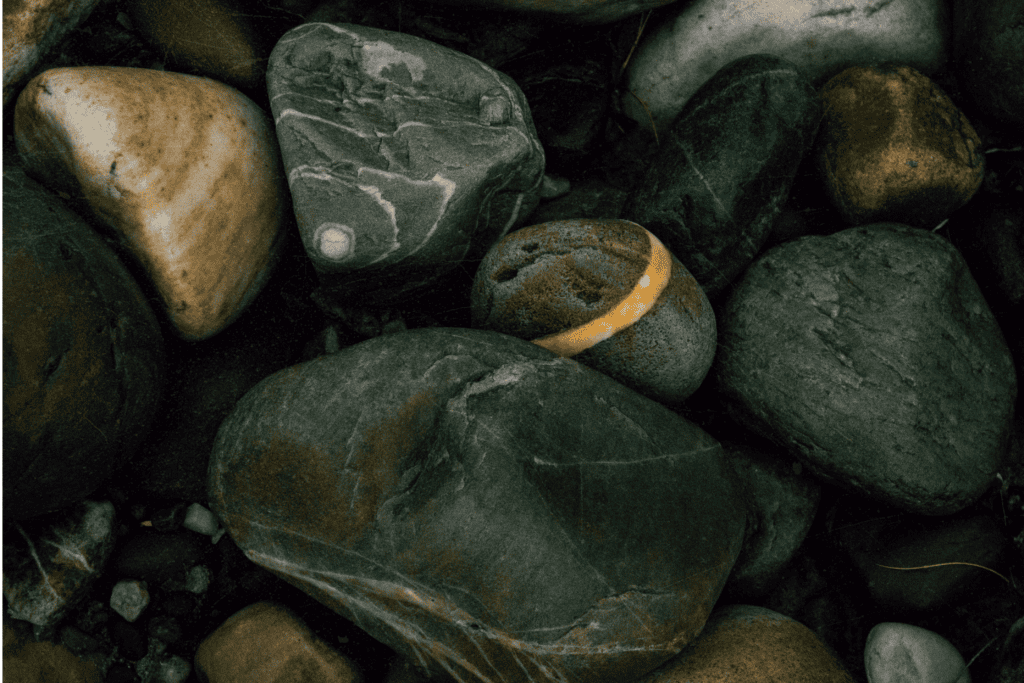
That’s a wishing stone! A stone aficionado friend recently came over and invariably we started looking at my modest rock collection. I used to collect them in earnest, now I do it for vibes. I do love a good rock. My husband got me back into it when on a summer’s day he decided he would dive to the bottom of the lake to gather rocks for me, and then on a winter morning he would come across a cool rock that he thought I might like. Now I really enjoy looking for wishing stones. We walk the shore of the Sound, toes in the sand, glitter on the sea, holding hands. How is it that some days combing the beach you find nothing and another day you find everything? Seems to be also how life works too. I still get excited when I find a really pronounced one–running my fingers around the quartz or calcite encircling them quiets the mind better than a 6th grader with a Pop It fidget toy.
The lore behind the stone myth is mysterious, its true origins lost to time. But it says that if you make a wish and throw the stone back to the waters it will grant you that wish. More cathartic, in my opinion, than plucking the petals from a flower to determine if “he loves me, he loves me not.” These little rituals and rhythms are so interesting to me. It looks similar to another Celtic ritual surrounding the Clach na Crìche (boundary stone) wishing stone. A large part of a stone on the coast of Scotland. There once was a stream that flowed by it. It was said that if you held the spring water in your mouth and passed through the stone three times it would grant you your wish as you held it in mind. Silence is the mechanism of the ritual. Chosen silence, something precious held inward instead of releasing it, and then something is given. Just like our little sea maid, chosen silence and then something given. Even as a child the birthday candle wish, the wish upon the scattering of a dandylion–it wouldn’t come true if you told someone, right? I don’t believe in wishes anymore, but I do believe this may echo something very true and I experience it every time I choose what to release and what to keep.
This echo appears in Andersen’s The Little Mermaid, the fairytale is explicit that not only using your voice has a cost, but also that chosen silence can also bring life, or save life in its own way. Our little sea maiden had silence forced on her and silence given. I hope that through maturity and discernment we can position ourselves to give silence when needed. Here’s the thing, casting pearls before swine and wasting them is one thing, wasting your time, energy and gifts and talents. But the verse continues and says, “If you do, they may trample them under their feet, and turn and tear you to pieces.” As a friend is fond of saying, pig headed people don’t deserve our precious heart. I am done being torn up because I presumed to give something precious to someone who could not care less.
Stone is ancient and important. From grinding our food to be able to digest it, to making shelter. To the great stones configured into cathedrals and monuments, to the haphazard structures of Stonehedge or Clach na Crìche. To the pebbles with which David slew Goliath and the stone that rolled away in the Garden of Gethsemane, stone has figurative and symbolic meaning to humanity. Maybe even literally as it is now scientifically documented that humans have an ideal frequency that is restored when touching earth, sand and stone. A stone of remembrance. A stone that rolled away. A Cornerstone that brought salvation.
Jesus. He never struck me particularly as quiet. He spoke in love, especially to women. He chastised his disciples. He spoke with authority at the age of twelve. He retreated and spoke with God alone often. He spoke of things no one had ever heard. He said to turn the other cheek, but also that the religious leaders were a brood of vipers devouring their young and that they were like white washed tombs–dead inside. But in a moment his silence decided our future.
He was standing before the Sanhedrin which was the gathering of religious leaders of the Jews. They were sick of His pushback, His challenges, His fierce and defiant tongue. They wanted Him dead. These leaders set up a system of perfectionism and legalism to not only keep them from disobeying God’s law accidently, but to keep their status. They added to God’s word and were judgemental and oppressive to the average Jewish person trying to get along. The Jews were occupied in the land, though they set themselves apart with their particular worship and customs, they lived among the Romans and obeyed their rule. Roman leadership was ever wary of rebellion from said oppressed people and largely left them to their own except for anything that looked like a mob or uprising. And they taxed them mercilessly. Pilate was one of these leaders, set over the jurisdiction of Jerusalem at this time. Herod was the Jewish King that was a figurehead to the Romans, but paranoid and desperate for security in his reign despite not following the Law of God. In Sunday school these were the figures who had mean faces on, dramatically slanted eyebrows, and for good reason it turns out. For they conspired to lead Jesus to a very specific moment. They finally had Him arrested and He stood before them. They could find no evidence against Him. Could you imagine? All of that fuss and evidence just slipped through their fingers? But finally, two men came to falsely accuse Him of public destruction. They asked Him questions but He chose silence. He would not defend Himself to those that wanted His destruction. He would not defend Himself to fools. He would not speak on His own behalf, perhaps for the sake of the world. For this moment was His last before He was sentenced to death on a cross. He was silent. In my mind’s eye I’ve always pictured Jesus standing in the middle of a huge room, walls and floors of stone. I picture Him staring these people down, back straight, yet with humility in His eyes. Perhaps someone clears their throat and the echo of it bounces around before true silence settles into the space. This is the second silence. The second silence that I long for in my life and that is elusive but waiting for me. The choice to not cast my pearls before swine. Jesus wasn’t about to give His precious, pearly words to these men consumed with fear, power, hate and hedonism. Jesus masterfully kept His silence with dignity and maturity, knowing that these people were not worth His voice. Though Jesus was the Lamb up against some fearsome foes, I dare say there are those in our lives that are not worthy to hear our voice either.
The sea maid chose silence and got eternity. Jesus chose silence and gave everyone else eternity. But what does this look like for ordinary people who aren’t dissolving into sea foam? What might we gain from choosing silence? Most of the time it is ordinary, but once in a while, it might just be extraordinary. When politicians rail against each other and essentially against us, maybe we don’t have to dive into every word they say and give our precious brain power to figuring everything out. When the workplace gets tense and you can’t put your finger on it, maybe just keep doing your job well and let it go. When family gossip about you, you don’t have to respond in defense. Your actions speak louder than words and God’s defense is a powerful one. For as Rudyard Kipling writes, “If you can bear to hear the truth you’ve spoken twisted by knaves to make a trap for fools…yours is the earth and everything in it.” It may only be internally that we receive from the silence, but isn’t peace worth it? It was to the sea maid, to Jesus, it is to me. Perhaps that is why I’m drawn to the wishing stone in this season: the fools and knaves around me seem less prominent with a reminder that they don’t matter as much as they once did. So my husband and I keep looking for our wishing stones and keep choosing time together on our peaceful little seashore. These stones that once represented a hope through making a wish, represent peace to me now. The cool smoothness in my hand, the gentle smell of brine, a reminder that I have more choice and influence over my own peace than I sometimes realize. The seafoam at my feet reminding me every time of a chosen silence. We do it because it gives us peace. So we will.
References and Inspiration:
Andersen, Hans Christian. Fairy Tales. Illustrated by Harry Clarke, Brockhampton Press, 1994. — containing “The Little Sea Maid.”
Clach na Crìche — The Wishing Stone. Wild Ardnamurchan, wildardnamurchan.com/ardnamurchan-rocks/clach-na-criche-the-wishing-stone.
Earth Frequency. Grounding and Earthing Research. earthfrequency.com. — for research on the health benefits of grounding and connection to the earth.
Kipling, Rudyard. “If—.” 1910. Poetry Foundation, poetryfoundation.org/poems/46473/if—. Note: The quotation in this essay bridges two non-consecutive stanzas of the poem.
The Little Mermaid. Directed by Ron Clements and John Musker, Walt Disney Animation Studios, 1989.
Woods, Kell. Upon a Starlit Tide. Tor Books, 2025.
Scripture
All Scripture references are taken from the New International Version.
Matthew 5:39 — But I tell you, do not resist an evil person. If anyone slaps you on the right cheek, turn to them the other cheek also.
Matthew 7:6 — Do not give dogs what is sacred; do not throw your pearls to pigs. If you do, they may trample them under their feet, and turn and tear you to pieces.
Matthew 23:27 — You are like whitewashed tombs, which look beautiful on the outside but on the inside are full of the bones of the dead and everything unclean.
Matthew 23:33 — You snakes! You brood of vipers! How will you escape being condemned to hell?
Matthew 26:59-63 — The chief priests and the whole Sanhedrin were looking for false evidence against Jesus so that they could put him to death. But they did not find any…Then the high priest stood up and said to Jesus, “Are you not going to answer?”…But Jesus remained silent.
Mark 14:55-61 — The chief priests and the whole Sanhedrin were looking for evidence against Jesus so that they could put him to death, but they did not find any…Again the high priest asked him, “Are you the Messiah, the Son of the Blessed One?”…But Jesus remained silent and gave no answer.
Luke 2:46-47 — After three days they found him in the temple courts, sitting among the teachers, listening to them and asking them questions. Everyone who heard him was amazed at his understanding and his answers.
Isaiah 53:7 — He was oppressed and afflicted, yet he did not open his mouth; he was led like a lamb to the slaughter, and as a sheep before its shearers is silent, so he did not open his mouth.
Ecclesiastes 3:7 — There is a time to be silent and a time to speak.